
Lickspittle
A Short Story

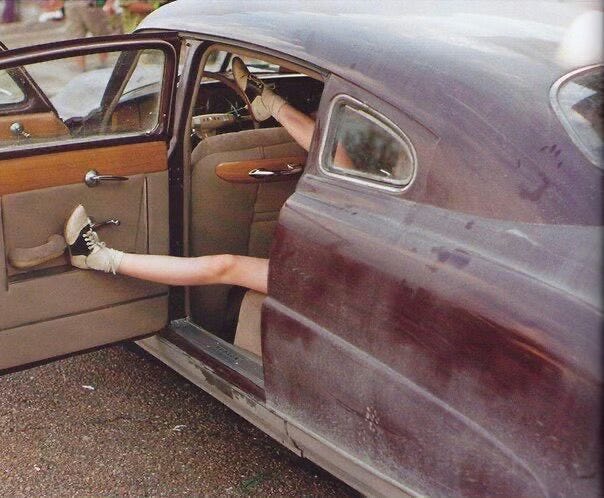
It began with a finger. Not the nagging kind, nor the gung-ho middle, but a lone index uprooted and left to gray and decay like a wad of chewed gum in the empty dirt lot next to Mac’s place, the one we used for overflow parking on restless nights sticky with spilled soda and insect repellent. The digit lay nestled among the ragged terrain of tire tracks and bootprints, waiting to be discovered.
The sky above was a morbid red - a Dantean inferno set ablaze by the setting sun. The clouds melted into oblivion and the birds took quiet refuge in the trees to the tune of the mosquitoes’ tuneless song. Parched sidewalks glowed like burning coals beneath the rubber tires of bicycles pedaling away from impending curfews and the last of the summer daisies hid their faces in blushing petals. We swung screen doors wide and stretched our hands outside, hoping to catch a sliver of burning sky for ourselves.
Mrs. Kildare declared Hell had cracked open over our heads and that we’d all fry like eggs. Principal Patrick cancelled that night’s meeting of the school board in favor of attending to his affairs. He was certain the Rapture had come. Mac was too busy wringing out the last drops of his busy season to notice the sky’s strange hue. He slung French fries and malted milkshakes through car windows and wiped the sweat from his bald head with the dirty rag he kept in his back pocket.
Mac sold burgers from a flamboyant shack aglow with the twitching light of a neon sign that painted all of Windham Avenue a phosphorescent blue. They were the most indulgent delicacy our town had ever known: smothered in gooey cheese, stuffed into a buttered brioche bun, and tenderly swaddled in a paper wrapper to keep them warm on the ride home, but they never lasted that long. We tore into them in the parking lot, peeling the paper back like Christmas wrapping. One bite sent torrents of grease trickling down our forearms and into the bags of fries glowing with fryer oil. Then we washed them down with double chocolate shakes, so thick and creamy that they sat at the bases of our stomachs like stones for three days.
People from all over flocked to our town just to get a whiff of the sweet-savory haze that haloed Mac’s place. It was typical for us to have to wait an hour for a burger, two if we wanted a shake. Even as we slipped down the other side of Summer into Autumn, Mac’s continued to pulse with popularity, so busy that Janie Atkinson’s father had to park in the empty lot next door. Throngs of people loitered about with their hands in their pockets, making idle conversation. Neighbors caught up with neighbors. Friends laughed with friends. Flames of passion were rekindled. Janie was on her way to say hello to her best friend, Betty Berkoben, when she saw it - the finger. She might’ve missed it had it not been for the silver ring that wreathed its middle like a belt, winking up at her in the red light.
It lay there, forgotten, like a half-eaten hot dog discarded in the dirt. Rusted blood lined the blue cuticle and mingled in the wrinkled gray flesh of the knuckle. The base looked like sausage left too long on the griddle, blotchy and burnt. Someone had cauterized not the wound but the sawed-off finger. Then, they’d burned the fingerprint clean off.
Janie picked it up. She rocked the finger back and forth in her palm. The petrified texture of dead flesh made bile rise in her throat and, choking on realization, she let the finger fall from her hand. It landed in the dirt without a sound. The smooth pad of the finger stared up at her with bare-faced simplicity. Janie’s face, typically alive with youthful vivacity and cheeks as red as cherries jubilee, receded into an acid white horror. Her features curled in on themselves, tightening like screws until the baby-fat of her face crumpled into wrinkles far beyond her years as though she had seen the entirety of her life unfold in the flesh of the finger. Janie opened her mouth to call for her father, but nothing came out.
Mr. Atkinson stood a world away, oblivious, doing an impatient shuffle with his hands stuffed into the pockets of his jeans while his son, Johnny, used him as a living jungle gym. Johnny climbed up his father’s back and hooked his legs over his shoulders, perching himself atop a towering steed. Mr. Atkinson approached Mac’s counter, the hapless bottom half of a two-headed monster.
Mr. Atkinson was a widower and a father of three who was secretly grateful when Janie, his eldest, begged for a bit of independence. It was a relief to relinquish the reins and allow her to roam free like a wild mare with the wind in her mane, trusting she would be home by mealtime. Thus, he did not take much notice of her absence while he stood in line at Mac’s, tugged this way and that by his sons.
Johnny and Jack were twins, distinctly Apollonian in appearance, but by all accounts tended toward a more Dionysian way of living - that is, as Dionysian as a pair of eight-year-olds can get. They were little sun-bronzed Gods, golden from their identical blonde heads to their muddy toes, sprouting like two unruly dandelions from Mr. Atkinson’s garden of serenity. They ran in rampant circles around their father, stretching his patience to its outermost limits, their grass-stained baseball uniforms glowing red and blue under the fiery sky and the buzzing glow of Mac’s neon sign. So engrossed was Mr. Atkinson in the lives of his sons - making sure they did not break things that ought not to be broken or eat things that ought not to be eaten - that Janie’s existence passed him by as quietly as the change in seasons.
When Mr. Atkinson returned to his car an hour later with three malted shakes in varying flavors, four double cheeseburgers with no pickles, and two boys wrangled into their best behavior by the promise of candy, he was not perturbed by Janie’s absence. Nor did he recede into worry when he scanned the red horizon and saw her standing with statuesque stillness among the dwindling crowd. He called her name, but Janie didn’t budge. She stood shell-shocked, staring at the space between her shoes as the blistering sky above her deepened into bruised purples. Mr. Atkinson furrowed his brow and called to her again; the mere idea of having to say her name twice coaxed a knotted tightness into his chest. When Janie did not respond for the second time, Mr. Atkinson began to feel blindly around for the reins he had dropped so long ago.
‘Janie!’ Johnny echoed, thinking his sister was playing some sort of game. ‘Janie, Janie, Janie!”
He squealed and ran out to her as Mr. Atkinson, tucking the greasy bag of burgers under his chin, struggled to restrain Jack. Jack wrestled against his father’s grasp as Johnny’s figure shrank in the red distance. He danced circles around his stupefied sister, pointed at something on the ground, bent down, and popped whatever it was into his mouth. It was then that Janie finally screamed.
In the wake of Janie’s discovery, our town turned in quiet unison to a man called Gap McKenzie. Gap was a part-owner of G&D Hardware alongside Dale Stevens. He manned the till while Dale dealt with business on the back end. Gap was a recovering alcoholic and a combat veteran who had stormed the beaches of Normandy some twenty years ago when he was a fresh-faced kid called Geoffrey. Now he had a face like a leather boot, grizzled by rosacea and a salt-and-pepper goatee that he toyed with when he spoke.
Gap did not like attention. He was a plain, hardworking countryman who’d spent his formative years as a laborer before he became a soldier. He was content to be one of the faceless many, an unremarkable cog in the machinery of society, and thus far, he had succeeded. But when Janie found the finger, our town pointed it, naturally, to Gap, silently naming him master of our finger-related furor.
We are not certain which one of us coined Gap’s moniker, nor do we recall when he had completed the transition from Geoff to Gap, but there was no question about why he had adopted the name. For some time after the war and before his sobriety, Gap worked in the old Pritchard Sawmill, where he lost his left middle and ring fingers to the teeth of a buzzsaw. Nothing remained between his index and pinkie but a rough, knuckle-edged Gap. Authorities and curiosity-seekers alike flooded the G&D to assail Gap with questions related to finger detachment; there seemed to be nowhere else to turn and no better expert on the subject.
‘I’m tellin’ ya, I don’t know nothin’ about no one’s finger,’ Gap barked at a pale-faced, crooked-toothed officer holding up a shiny photograph of the finger tattooed with gravel and Johnny Atkinson’s teeth marks. Gap pressed his hands against the counter that separated them. The green surface was overlaid with glass, beneath which beamed the various typefaces of business cards and local election propaganda skewed in favor of one side.
‘Can’t you tell us nothin’ about, say, how it was removed?’ the officer asked, tapping the black and white base of the photographed finger.
‘No, I can’t.’ Gap tossed the pennies in the Take-A-Coin cup like a salad. ‘And what does it matter anyhow? Finger’s gone and so is whoever it belonged to.’
‘It matters greatly, Gap,’ said a man with a sun-darkened face that folded in on itself with countless creases. A Sheriff’s badge glinted on his chest, tickled by the white sunlight that ambled into the hardware store through wide windows. He wore his Stetson hat at a jaunty angle unsuited to his grave demeanor.
‘If we know the method of dismemberin’,’ the Sheriff said, ‘Then we can find the weapon what done it and the man that wielded it.’
Gap shook his head. His long, coarse hair shot through with stripes of silver grazed his shoulders.
‘Well, I don’t know how it happened,’ he said. ‘I weren’t there. All’s I know is a child found a finger in a parkin’ lot, and I’m catching the flak for it. I weren’t even at Mac’s that night. Whyn’t you ask him how it got there? ‘Cause the only fingers I know anythin’ about are my own, and that ain’t one of them. Iffen you find a couple on the sawmill floor, come talk to me. ‘Til then, you’re holdin’ up my line.’
The Sheriff’s sandpaper face softened into a hangdog stare. He looked at Gap for a long time before he slapped his hand on the counter and walked out of the hardware store with his junior officer in tow.
Sunlight beat against the sidewalk like a gloved fist. The sky had returned to a polythene blue decorated here and there with toy clouds that gave our town the look of make-believe. The Sheriff took a pair of dark sunglasses and a cigarette from his breast pocket and brought both to his face. The junior officer leaned against the side of the hardware store, feeling the warmth of the brick pass through his starched shirt. The Sheriff removed his hat and dabbed the sweat from his puckered face. Sunlight winked off the bald spot at the back of his head, piercing through the thin veneer of his gray hair.
‘Why’s it so important anyhow?’ the junior officer asked, squinting at the photograph in his hands as though trying to make sense of it.
The Sheriff took a long drag of his cigarette. Then he tossed it to the sidewalk and ground it to powder with the heel of his dusty black shoe.
‘It ain’t,’ he said. The junior officer blinked, puzzled. ‘One finger ain’t so important in the grand scheme of things. But I reckon it were important to whoever lost it. That is, if they’re still breathin’. Maybe they’re dead and we’re just gettin’ ‘em back one piece at a time like a puzzle. Maybe it’ll be a foot next. Or a head. Naw, it ain’t about no little finger. There’s got to be more to it than that, son. I was only hopin’ Gap might help us find out what more there is.’
‘How’s he supposed to know anythin’? Just ‘cause he lost some fingers, too? Was a buzzsaw that got his, everybody knows that, Sheriff.’
The sheriff spat a wad of white saliva to the ground and returned his hat to his head.
‘Weren’t no buzzsaw,’ he said. ‘Gap lost those fingers, sure, but it weren’t by no buzzsaw. See, it’s like this, one night he came stumblin’ into the station drunk and bleedin’ all over. He ain’t never seen so much blood since the war, he says. All of it, flowin’ out of his hand like wine. Buzzsaw is quick. Woulda cut ‘em clean off. But this - why his hand looked like an animal done took a bite out of it. Naw, this wasn’t no buzzsaw - someone cut through him like he was a steak. I know it. Only he never did tell who done it. I was hopin’ - well, I was hopin’, since now it was someone else that’s hurt, he might’ve finally said who.’
The junior officer said nothing for a long while. He tucked the photograph under his arm and sighed.
‘S’an awful stretch,’ he said finally.
‘I know.’ The Sheriff shook his head. ‘But it’s somethin’ to go off. Somethin’s better’n nothin’. If Pritchard was still around, he’d tell you: ain’t no one never lost nothin’ in his sawmill. Well, ‘cept for Fred Hickock, but that was his own damn fault.’
Curious crowds had swallowed the Atkinson home. Ladies peered over the rims of their sunglasses as they slowed their gait. Husbands volunteered to walk little yappy dogs just to catch a glimpse of how life had continued inside the Atkinson home, imagining one finger had sent their wheel of fortune spinning in the other direction. Lollipop-sucking girls and boys in bicycle gangs swarmed the place like some sort of circus oddity, crunching corn pops and littering Mr. Atkinson’s green lawn with carelessly discarded wrappers. When Mr. Atkinson wasn’t busy spoon-feeding soup to Johnny, who had fallen ill after his finger-licking snack, he was shooing prying eyes from the yard and the police from his doorstep.
The Sheriff came by daily, poking holes in the Atkinsons’ limited peace with his repeated questions.
‘I don’t have any more answers,’ Mr. Atkinson said finally, his voice clipped, his glasses sliding down the bridge of his aquiline nose. ‘She found a finger. I don’t see why you must keep bothering her. She had nothing to do with how it got there - she’s just a child.’
Still, the Sheriff plodded up and down the block, picking up after the careless children, sinking low in the front seat of his cruiser, waiting for something to happen, for the heavens to part and shine their light upon the missing pieces of his puzzle.
Janie’s world shrank down to the size of her blue bedroom. The walls were the color of a dusky sky and seemed just as endless. They stretched on forever and ever, too far for her to reach, though she walked endlessly, carving tracks in the moon-hued carpet with her pacing. Through the keyhole of her closed door burned the golden eye of her brother Jack, peeping like a private eye in case Janie’s behavior should descend further into the well of peculiarity. Mr. Atkinson had promised him a quarter in exchange for his spying services.
Jack watched his sister plod and pace, her frail figure silhouetted by the lazy light of so many blue afternoons. It seemed she did nothing but walk and whisper to herself, drawing connections between points in her mind like constellations only she could see. Her fingers worked at her sides as though she were counting. Jack imagined all the things he was going to buy: a new baseball, a case for his pencils, a Mickey Mantle jersey, a new comic book, and lots and lots of candy to eat in front of his brother.
Betty Berkoben stopped by nearly every day, hugging the assignments Janie had missed to her chest like prized secrets. She spread them out on Janie’s white eyelet duvet and explained what they were.
‘You missed the first two scenes of Hamlet, so you’ll have to read those on your own. And here are the instructions for the home economics project - you weren’t there to pick partners, so you have to do it by yourself. I’ve partnered with Ginny Pearson, and I’m going straight to her house after this to work on it. Why didn’t you ever tell me she lived down the block? Her father works for RCA, so she has all the newest records - and they have an in-ground swimming pool.’
Betty fingered the lace edging of a lampshade. Janie chewed a lock of her own hair.
‘I would have partnered with you, but you weren’t there, so you can’t be cross,’ Betty said. ‘It isn’t very fair, you know. All you did was find some stupid finger, and now everyone’s talking about you.’
She sat on the edge of Janie’s bed and crossed her ankles, uniting the ruffled hems of her socks in a cotton-blend kiss.
‘But,’ she began, inspecting her cuticles with an air of mock detachment. ‘None of this would have happened at all if it weren’t for me. I mean, you were on your way to see me when you found it. It could’ve just as easily been anyone else. It could’ve been Ginny Pearson - or me. And if I’d found it, I wouldn’t be sulking around in my room, I’d be out telling everyone all about it. What’s the matter with you anyhow? It was just a stupid finger. Oh, and there’s a Biology exam on Tuesday. Mr. Cartwright told me to tell you. He said there’s no make-up if you miss it. Janie?’
The mattress whined as Betty leaned forward. She bit her lip, smudging the red lipstick she’d stolen from her mother’s vanity.
‘Fine, be angry,’ Betty said. Johnny’s retching pierced through the walls like water through a sieve. ‘But I’ve already partnered with Ginny, and it’s too late for me to change. She’s waiting for me now. She said I can borrow whatever albums I want from her collection.’
Janie watched her best friend rise and vanish like a mirage. Betty shimmered through the soft veil that separated Janie from the world. She was a good friend for bringing Janie all the work she’d missed. It was only too bad that Janie hadn’t heard a word Betty had said.
Janie was twelve when her mother died. An automobile accident. Her brothers were too young to understand, and maybe Janie was, too. She had seen her mother drive off that day. When she didn’t return, it was easy to pretend she was somewhere else, on a long trip far, far away.
Janie didn’t know what had caused the accident. From what she could piece together, her mother’s car had rammed into a pole so hard that the metal hood bent into a wrinkled U and its driver was launched through the windshield. The newspapers had called it the most gruesome accident the state had seen in years. They said her body had gone to pieces on impact.
Janie imagined her mother scattered about in the road like an unfinished puzzle, the blue marbles of her eyes rolling over the pavement, the claw of her ringed hand softened by the embrace of death, but it was little more than a spooky story she told herself. In her mind, her mother was simply elsewhere. Then, she found the finger. For the first time, she realized it was possible for a body to disunite. For the first time, she realized it was possible her mother was dead. She wondered if she had found a piece of her.
The faces that pressed in upon Janie were shrouded in dreamlike shadow. She saw them only through the gossamer haze of the veil which had dropped, suddenly, atop her mind like a sheet upon which images only she could see appeared to be projected. Ants twittering in the dirt, antennae flying wild. Blue shoes. Black shadows. The crisply whispered secrets of confession. A churning sea of maggots. The finger, rotting in the sun.
Janie tried to place these images among the darkened backrooms of her memory, but they were not hers to keep. They flickered before her like scenes from an unfamiliar movie and dangled with the threads of an unfinished story that called to her like a siren song.
She was restless. The days stretched on, pulled slowly along like a grim parade until the sudden clap of night swallowed the Atkinsons into darkness. Mr. Atkinson sedated himself with a sleeping pill while Johnny floated on the warm sea of fever dreams and cough syrup. Jack, the determined spy, lay sprawled out on the pistachio-colored carpet, slipping into sleep like it was a warm coat. But Janie could not achieve such relief. Her frenetic feet carried her quietly down the stairs and out into the black night.
Janie wandered the deserted streets of our town like a purgatory-bound spirit in search of something none of us could understand. Of course, we didn’t know about these late-night constitutionals then, and we might never have, had she not wandered all the way down to Main Street.
Gap stayed late at the G&D that night to receive a late delivery. He owed Dale a favor and figured the easiest way to pay him back was to give the old boy a night off. Dale took his wife to dinner in the city. Gap signed the dotted line and left the boxes stacked in the backroom for Dale to deal with in the morning. He was locking the front doors when the blue-black velvet of the night shivered and parted to reveal the luminous figure of a young girl. Gap hoped that a will-o’-the-wisp had finally lighted upon him to reveal his path to prosperity. His vetted heart faltered when he realized that it was Janie.
She did not stir when Gap called out to her. Her pale eyes peered through him as though he had ceased to exist. Something way down in Gap’s stomach began to unzip; out billowed a tremulous cloud of inexplicable terror. The bones of his missing fingers pulsed.
Gap returned his key ring to his belt loop. They jingled like wind chimes in the night, beating against hip hipbone. The sidewalk cracked like a stiff spine under the weight of his paint-splattered work boots.
‘Janie?’ he called again. Gap planted his feet on the ground, steadying himself as Janie tripped silently toward him, wavering in her cotton nightgown. The moonlight bleached the soft tendrils of her blonde hair bone-white. Wind cradled the hem of her nightgown and rocked it back and forth. Gap tasted fear on his tongue, but he swallowed it like spit.
‘Looky here, lil lady,’ Gap said. He cleared his throat. ‘You’re apt to catch cold out here this late in nothin’ but your pajamas. Whyn’t I give you a ride home?’
Janie was close to him now, hardly a foot away. Gap could count the little blonde curls blooming like sprays of baby’s breath from her forehead. She looked up at him, and his breath caught in his throat like a knit sweater on a loose nail.
Her eyes were bloodshot, cracked through with red veins like the sky on the Fourth of July. Vacuous black pupils swallowed up the feathered blue of her irises.
Gap toyed with his mustache out of habit, brushing the bristled hairs from his lip with a lonely index finger. With a hand like a lily petal, Janie reached out and ran her fingers across the bare-knuckled space where Gap’s fingers had once been. She touched the puckered flesh, feeling the bumps and ridges where bone abutted skin, and said in a voice that crackled like gravel under a rubber tire: ‘Silver?’
Gap said nothing. He stood immobile as Janie withdrew her hand and stumbled along into the night. He remained that way for a long while, his remaining fingers hovering over his trembling lips.
Early the next morning, Gap warned the Sheriff that Janie had been wandering the streets alone at night. Then he climbed into his truck, green paint receding like the tide from a rusty beach, and left our town for good.
It was a week before another appendage appeared. This time, there were three fingers, and this time, we knew exactly whose they were.
No amount of mutilation could deter hungry customers from Mac’s counter; in fact, it seemed to entice them. Out-of-towners lingered even as we waded deep into the off-season. A chill swept through the air and knocked the leaves from their wooden perches until they buried the ground, turning to potpourri beneath our feet. Strangers loitered in Mac’s parking lot. We pretended not to notice their roaming eyes magnetized to the ground, hoping in their most secret hearts that they, too, might find something macabre and newsworthy. A few brought shovels. One unearthed a pair of minie balls and the fallen button of a Union soldier. But mostly, the strangers found only fries writhing with hungry ants and littered cigarette butts. That is, until Mac threw open the back door of his burger shack and waddled out into the white afternoon, clutching three bratwursts in his right hand. Then he keeled over and landed face down in the dirt.
Mac was a corpulent man, heavy even before he was encumbered by the millstones of unconsciousness. It took three of us to roll him onto his back. He lay there with his dirt-flecked face to the sky like a corpse as blood seeped into the apron that swelled over his potbelly like a filthy ski slope. We thought he was dead. Then, we noticed the soft rippling of his apron with Mac’s shallow breath. We pried the three bratwurst from his hand and discovered they were his own fingers. Blood spilled from the stump of his opposite palm.
A surgeon three towns over was able to reattach Mac’s fingers within the hour. When Mac could once again string together sentences, and his sutured hand had been mummified in beige bandages, the hospital staff asked him what had happened. A shadow flit fae-like across the selenic landscape of Mac’s face, darkening it for a moment so fleeting it might have been dismissed as the sun ducking behind a cloud. His pink tongue darted out and dampened his lips.
‘Nothin’,’ he said, squeezing a laugh through a pinhole of a smile. ‘Just an accident, s’all. Knife slipped. Butcher knife. ‘Spensive one, too. ‘Least I know I got my money’s worth.’
Mac laughed again. His smile slipped.
‘Just an accident,’ he repeated, his voice smaller this time, further away, as though speaking through a telephone. His eyes flicked toward the figures passing in the hallway, startled by the clicking of patent leather shoes. ‘An accident, s’all.’
The next day, Mac returned to business as usual, a touch pallid and drizzle-grey about the eyes but otherwise our familiar, easy-going Mac. When the Sheriff sidled up to Mac’s counter, Mac smiled and offered his good hand.
‘Howdy, Sheriff,’ he said with a grin that stretched between his ears like a hammock. ‘The usual?’
The Sheriff nodded. His eyes vanished under the brim of his hat as he fished around in his pockets for the necessary change. He stood alone, emerging upright from the sun-blanched landscape like a wiry birch.
Mac dropped the Sheriff’s coins into the register. ‘Should only be ‘bout five minutes, Sheriff. I’ll be speedy just for you.’
The Sheriff nodded and leaned his elbows against the counter. It was quiet at Mac’s. Barely noon, the Sheriff had beaten the lunch rush, but the threat of it loomed over his head like an impending storm. Soon, hungry mouths would form a ritualistic line in the noon sun, clutching coins to drop in the coffers like sinners eager to snap up their indulgences. For now, it was only the Sheriff and the cool wind which whispered against the back of his neck.
‘Say, Mac,’ he said, though Mac’s back was turned to him. He watched the sweat slip down Mac’s bald head as he busied himself over the grill.
‘Heard ‘bout your hand,’ the Sheriff continued. ‘Amazin’ what modern med’cine can do, ain’t it?’
Mac shot a grin over his shoulder and held up his mummified hand. The bandages were already frayed and stained with grease spots and mustard.
‘Sure is!’ he replied.
‘How’d it happen?’
The back of Mac’s neck stiffened. The sweat wobbled tentatively down his pink flesh and disappeared beneath the neckline of his damp t-shirt.
‘Accident. Knife slipped,’ he said and barked out a dry laugh. ‘You’d think I’d know how to use one by now.’
‘You sure would,’ the Sheriff chuckled. He drummed his fingers on the red and white tiled counter. A tip jar glittered in the sunlight like dewdrops as a feathery cloud dovetailed in the parched blue sky behind him. ‘Quite the coincidence, innit?’
‘Hm?’ Mac shoveled fries into a paper bag as a burger patty sizzled on the grill, browning in the heat.
‘I said it’s quite the coincidence. Seems everybody’s losin’ their fingers all at once.’
Mac tucked the cooked patty into the plush bed of a burger bun. ‘Yeah,’ he said. ‘Divine timin’. Say, I can’t recall whether you take ketchup or mustard?’
‘Mayonnaise, if you’ve got it. Mac, how’d it really happen? I know it weren’t no slip of a butcher knife.’
Mac dropped the burger into the paper bag heavy with fries and grease and thrust it at the Sheriff. ‘Here’s your food, Sheriff.’
The Sheriff hesitated a moment. Then he took his lunch and turned to leave.
‘You know I can’t say nothin’,’ Mac said. ‘Might end up like Fred Hickok and lose more’n a finger if I do.’
The Sheriff squinted in the midday sunshine. It poured over him like molasses, slowing his senses. Windswept dirt thrashed at his boots.
‘What’s that?’ he asked.
‘Just let it be, Sheriff. It’s the way things are.’
A moment of silence, heady with the weight of fryer oil and words unspoken, passed between the two men. The Sheriff shifted his weight, hooking his thumb around his belt loop.
‘You know where Gap went?’ he asked. Mac fidgeted with his bandages.
‘Not a clue.’
‘You know why he left?’
‘Not anything’ you don’t already know.’
‘Either you think I know more’n I do, or you’re playin’ the fool, Mac.’
The Sheriff made his way back to his beaten cruiser and sat down heavily in the driver’s seat, tossing the grease-soaked paper bag into the back. His keys jingled in the ignition, and the engine crept, groggily, back to life, clicking and whirring before settling into a smooth purr. The car stank of cigarettes, and a mountain of ash had risen like a molehill from a metal tray below the radio dials. Mac watched from behind his counter as the cruiser lurched forward, dirt snapping like popcorn kernels beneath the tires, and rubbed the back of his bandaged hand.
Janie was kept under lock and key after her midnight run-in with Gap. Keeping an eye on her was easier now that Johnny was in good health and both Atkinson boys were handed back to their school teachers like naughty puppies returned to the pound. Steady supervision proved to be good for Janie, whose color had begun to creep back into her cheeks, and her voice once again took root in her throat. Mr. Atkinson, although sleep-deprived and weary, was otherwise pleased to see the wispy figure which had been his daughter of late harden around the edges and become solid once more. She had even begun to return to her schoolwork.
One thing, however, continued to alarm Mr. Atkinson: Janie’s memory. Everything was hazy to her, as though someone had run their fingers across the still-wet canvas of her mind, dragging the colors around until the past and present became one nauseous blur. She did not know how many weeks had passed since that evening at Mac’s. It might have been a moment or a decade ago. It might have been a dream.
Betty was right when she said that everyone was talking about Janie. Though the sea of school children in the front yard had parted and nosy local newspapermen had given up asking unsuccessfully for statements, the mind of our town still buzzed about Janie. A grievous feeling of sorrow and sympathy pressed in upon us as though she had died, when really only a part of her had: that shiny, happy purity all of us are born with and eventually lose like baby teeth. The finger had lodged itself in the throat of Janie’s innocence until it shriveled up and died like a flower in a drought. Our grief for Janie was our grief for ourselves.
Women who walked past the Atkinson house pushing prams shook their heads and pressed their fingers to their lips. Men pursed their mouths and said, ‘Damn shame.’ We sent her flowers and casseroles. We said her name in our prayers. The Mayor made a personal call to the Atkinson house with his good friend, Reverend Lovelace.
The Mayor and the Reverend cut menacing figures in our town. They looked like a squat gangster trailed by his towering goon. The Mayor possessed a sturdy, barrel-like body, which he dressed up in big, boxy suits, imagining that width made up for what he lacked in height. He broadened his shoulders with padding until they became a solid shelf for his round head, which he topped with a white Panama hat like a dollop of whipped cream. He wore shiny blue shoes that click-clacked when he walked, and smiled a sharp, cheshire cat grin stuffed with too many tiny teeth.
Reverend Lovelace was something like our town’s Rasputin, towering in the Mayor’s shadow, clad in dark clerics draped over a cadaverous frame. His oblong face was inlaid with tiny features sharp enough to cut, and his stooped shoulders seemed to lurch away from the rest of his sinewy body as though it repulsed him. And yet, the Reverend bore a certain charm which returned him to humanity despite his vulture-like appearance.
The Reverend Lovelace had amassed a sort of hypnotic power in our town, his knowledgeable presence intoxicating the minds of the masses to whom he preached. And preach he did, often and in public spaces, drawing awed crowds as he beat passionately against his chest.
The Mayor entered the Atkinson house with a flourish and the flash of a camera, trained to entertain like a pageant girl, trailed by the Reverend and a nine-fingered photographer for our town’s newspaper. Mr. Atkinson tried to send the photographer away, but when he spoke, his voice fell limp to the floor like a balloon popped by the Mayor’s boisterous bravado. The Mayor cupped his palms around Mr. Atkinson’s hand like a hungry mouth and shook it feverishly.
‘Very pleased,’ he boomed. ‘Yes, very pleased, indeed. And what a wonderful home!’
The Mayor flashed a dazzling smile, and Mr. Atkinson blinked, dazed by the sudden scream of a flash bulb.
‘Can’t tell you,’ the Mayor said. ‘Can’t tell you how sorry I am. Too much - too much for a child to bear! Lucky - lucky she isn’t scarred for life. But that’s our stock, yes, sir, resilient! Strong! God Bless our little town!’
The Mayor flailed his fists around as he spoke, still smiling. He was like a firecracker set off indoors, bouncing frantically from wall to wall and shooting sparks from his smile. Mr. Atkinson paled in his presence - he mumbled something about the honor it was to receive him. He offered the Mayor a cup of coffee. He did not notice the shadow slinking up the stairs.
Reverend Lovelace’s fingers trailed along the bannister, his gangly figure stalked by the seeing eyes of family photographs hanging in crooked frames. His steps were measured and light, quite as cat’s paws on the Atkinsons’ carpet. He could hear the muffled voices of boys, hiccupping and giggling as they engaged in secret hijinks behind closed doors. He held his bible like a prop, positioning it so the gilt-edged pages winked in the light like new pennies, and edged toward an open door.
Janie sat at the foot of her bed with her knees drawn to her chest, watching a celluloid drama unfold in grayscale on a little television set. Her freshly washed hair soaked the back of her sweatshirt and sewed damp coins onto her striped pajama shorts. The Reverend knocked lightly on the open door and entered the room before Janie noticed he was there. She blinked and stuffed a finger into the bunched pink tube socks she wore, scratching her ankle.
‘Hello, Reverend,’ she said softly, the soft dandelion tufts of her voice blooming from nymph-like lips. Reverend Lovelace bowed his head and inhaled the sweetness of the girl’s room: four blue walls, a silk-skirted vanity, a slew of stuffed teddy bears gathered in a pyramid at the head of her white eyelet bed. He set his bible down and touched one of the bears tenderly, taking its velveteen ear between his finger and thumb.
‘Quite the collection,’ he mused to no one in particular, casting his eyes toward the heavens. They rolled around in their cavernous sockets like two walnuts, their shells cracked and veined with the amber glow of hellfire.
‘Daddy bought me that one in Niagara Falls. That was two summers ago, now.’
The Reverend smiled, mistaking the bear’s goggle-eyed stare for adoration.
‘They must bring you much comfort,’ said Reverend Lovelace. He did not give Janie enough time to answer before his honeyed voice once again took flight. ‘I hear you’ve had quite a shock, dear Janie. I was very sorry to learn what had happened - something so gruesome can corrupt a mind as pure as your own. Especially if it were to lead one astray. I haven’t seen you at service lately.’
The Reverend fondled the teddy bear as he spoke, grinding its fur between his fingers like powder. He had the long, nimble fingers of a whittler, as deft and pale as an egret pecking its quiet way through smooth waters. They exploded around him like fireworks when he preached, soaring through the air, carving great arcs in the sky, beating blindly against his chest as white spit gathered in the fevered corners of his serpentine mouth. But here, in Janie’s bedroom, he seemed somber, silken almost, as he slipped noiselessly toward Janie and cupped her petal-soft face in his egret hands.
‘In times of hardship, we must turn toward the Lord, not away from him.’
‘I was ill,’ Janie whispered. She could hear the Mayor’s muffled voice beating against the walls like one of Jack’s baseballs. The Reverend’s hands were cold and damp on her face.
‘I understand,’ he said. ‘The Lord understands. And he forgives, for he is kind. He is so very kind. He has sent me to you to clear your mind of calamity. Give up your horrors, Janie. Give them to God. Never speak of them again.’
The Reverend’s hands tightened on Janie’s face. They seemed to be trembling. His walnut eyes bulged from their black caves. Something bobbed and clicked in the pale flesh of his throat. Deep inside Janie, something clicked as well, releasing like a latch, and the door of her memory swung wide open.
The Reverend saw this as it occurred. The opening of a previously locked drawer in Janie’s mind was evidenced by a quiet shift in her eyes - a retraction of the pupils, a deepening of the blue. He felt something change inside her head and dropped his hands suddenly to his sides as though he feared being burned.
‘I’ll give them up,’ Janie said fearfully, pleading with her eyes. She flexed her fingers. A creak of the stairs startled the Reverend. He looked at the open door and touched his fingers to his lips.
‘Yes,’ he said distractedly. ‘Very good. Very - good.’
The Mayor appeared in Janie’s doorway, her father behind him, watching over her like a guardian angel. The photographer had been left downstairs. Mr. Atkinson had put his foot down.
‘Well!’ the Mayor said. ‘Well! Everything settled, then?’
His lips curled into an impish grin. Janie thought he looked like Rumplestiltskin.
The Reverend brightened suddenly, turning back on like a lamp. He glowed with a false light that only went as deep as his flesh.
‘Oh, indeed,’ he said. He picked up his bible and thumped it with his thumb. ‘Yes, indeed. I’m certain you will find your daughter much refreshed, Mr. Atkinson. I spoke what the almighty willed, and I believe her faith has been restored.’
The Mayor clapped his hands. ‘Delightful!’ he said. ‘Yes, yes! Dee-lightful!’
The Reverend looked at Janie one last time. His light flickered. Then, he and the Mayor turned to go, swept along in the windy wake of Johnny and Jack as they barrelled down the stairs and exploded onto the front lawn.
The Reverend and the Mayor stopped a moment to watch the boys at play. Johnny and Jack launched a blue rubber ball between them, catching it in sticky hands freckled at the knuckles. The photographer busied himself unloading his equipment into the shiny black car blemished with political bumper stickers that he had driven the Mayor and the Reverend in. He smiled to himself as he thought of the honor.
Jack released the ball. It hurtled through the air, grazing Johnny’s fingertips, before landing with a rustle in a shrub at the foot of the yard. They did not see it roll out the other side and bump into the Mayor’s click-clacky shoes. He waited until both boys were face deep in the shrub before he stooped down and placed the ball in his pocket.
‘You lost it!’ Johnny cried, ripping at the shrub. ‘That was my favorite ball, and you lost it!’
‘No, you did,’ Jack said as he raked at the dirt with his fingers. ‘You should’ve caught it. Anyway, it was my ball to begin with.’
Johnny came up for air. He balled his freckled fists at his sides and stared at his twin, seething.
‘It was mine,’ he snapped. ‘You lost it.’
Jack extricated his blackened hands from the dirt and swung them around on his brother. They wrestled one another to the ground, a blur of identical limbs and mirrored grunts. The Mayor chuckled.
‘Goodbye, boys!’ he called.
The twins were too angry with their own reflections to notice the bulge in the Mayor’s pocket as he left them to fight one another in the front yard. They did not even break apart when they called in unison, ‘Goodbye, Mayor Silver!’
This is gas
So well written. Great story. Could be a movie!